
Cat Straining to Urinate? Treat a Possible Blockage as an Emergency
On this page
- Quick answer
- Recognize urinary warning signs
- Understand why blockage is an emergency
- Do not delay trying to distinguish urine from stool
- Call and transport safely
- Avoid harmful home actions
- Bring useful observations and records
- Know what veterinary evaluation may involve
- Follow discharge instructions closely
- Monitor the litter box without assuming prevention
Quick answer
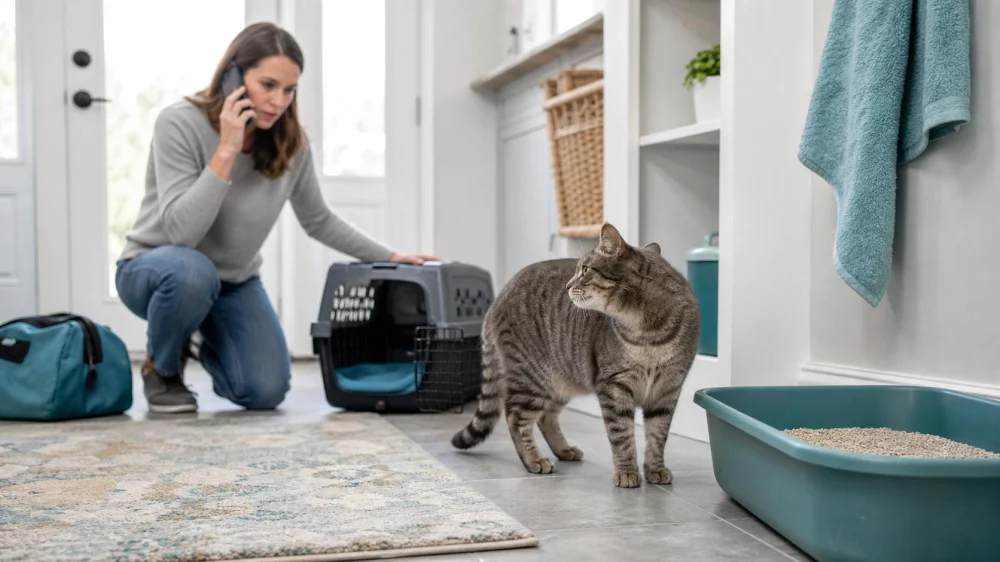
A cat repeatedly entering the litter box, straining, crying, licking the genital area, or producing only drops—or no urine—may have a urethral obstruction. This is a life-threatening emergency, especially in male cats. Call the nearest emergency veterinary hospital and leave promptly. Do not wait overnight to see whether the cat improves.
Do not press the abdomen, try to express the bladder, give human pain medicine, offer leftover antibiotics, force water, or attempt a home catheter. Put the cat in a secure carrier, bring medication and medical records, and tell the clinic when normal urination was last confirmed.

Recognize urinary warning signs
Signs can include frequent litter-box visits, prolonged squatting, straining, small urine clumps, blood, urinating outside the box, vocalizing, genital licking, hiding, restlessness, vomiting, reduced appetite, weakness, or a painful-looking abdomen. Some cats show only subtle changes at first.
Count actual urine clumps rather than assuming a squatting cat passed urine. In a multi-cat home, isolate the affected cat only if it can be done quickly and without delaying transport. A clean empty box may help confirm output while you call the clinic, but it is not a diagnostic test.

Vetco Total Care Animal Hospital
AvondaleMaricopa CountyArizona
10190 W McDowell Rd, Avondale, AZ 85392, USA
Understand why blockage is an emergency
Cornell University’s Feline Health Center calls urethral obstruction a true medical emergency. When urine cannot leave, kidney function, fluid balance, and electrolytes can deteriorate rapidly. The condition can become fatal without immediate treatment.
Male and neutered male cats are at higher risk because their urethra is longer and narrower, but any cat with difficult or absent urination needs urgent veterinary assessment. Bladder inflammation, stones, plugs, infection, or other disorders can look similar at home.
Do not delay trying to distinguish urine from stool
Straining to urinate can resemble constipation, and owners may see repeated box trips without knowing which system is involved. Both problems deserve veterinary advice, but inability to pass urine is immediately dangerous. Tell the emergency clinic that the cat is straining and that urine output is uncertain.
Do not give a laxative, enema, mineral oil, or fiber as a trial. Some human enemas are toxic to cats, and forcing treatment wastes time. A veterinarian can examine the bladder and determine which tests are needed.
Call and transport safely
Call ahead so the clinic can confirm location, entrance, current capacity, and transport advice. State the cat’s sex, age, symptoms, last normal urine, duration, vomiting or weakness, medications, and history of urinary disease. If the first clinic cannot receive the cat, ask for the nearest emergency option and start traveling.
Use a secure carrier lined with an absorbent towel. Handle gently because pain can make a familiar cat bite or scratch. Keep the vehicle temperature comfortable, minimize delay, and do not feed or give medicine unless the clinic instructs you.
Avoid harmful home actions
- Do not squeeze or massage the abdomen or bladder.
- Do not insert anything into the urinary opening.
- Do not give acetaminophen, ibuprofen, aspirin, or another human medicine.
- Do not reuse antibiotics, urinary relaxants, or pain medicine from an earlier episode.
- Do not switch diets as an emergency treatment.
- Do not delay for a pet-store remedy, telehealth appointment, or urine sample.
If the cat collapses, becomes unresponsive, has difficulty breathing, or develops pale, blue, or gray gums, tell the clinic while en route and follow emergency instructions.
Bring useful observations and records
Bring the current medication list, medical history, recent lab results, diet name, supplements, previous stone or urine analysis, and details of past blockage. Photograph the litter box and any urine or blood without delaying departure. Note changes in drinking, appetite, stress, routine, household cats, or access to plants and toxins.
Do not try to collect urine by pressing the cat or waiting for another box attempt. If a naturally passed sample already exists, ask the clinic whether to bring it and how; emergency evaluation should not depend on it.
Know what veterinary evaluation may involve
The team may triage heart rate, breathing, temperature, hydration, pain, bladder size, and overall stability. Blood work can evaluate kidney values and electrolytes; urinalysis, imaging, or culture may help identify the cause. An obstructed cat often needs sedation or anesthesia, urinary catheterization, pain control, fluids, and monitoring.
Treatment and hospitalization depend on severity, duration, recurrence, and complications. Ask the veterinarian to explain the confirmed diagnosis, immediate risks, estimated costs, monitoring, and what would change the plan. Do not authorize or refuse a procedure based only on an online description.
Follow discharge instructions closely
Use each prescribed medicine exactly as labeled and complete monitoring as directed. Confirm the diet, water plan, litter type, activity, recheck date, and expected urine pattern. Ask what amount of straining or blood may be expected and which signs require an immediate return.
Keep the cat in a quiet area with an accessible clean box when instructed, and track time and size of urine clumps. If straining returns, output falls, or the cat vomits, hides, stops eating, or seems painful, contact the veterinarian immediately rather than repeating old medication.
Monitor the litter box without assuming prevention
Provide enough clean, accessible boxes for the household and monitor each cat’s normal pattern. Encourage water intake only through veterinarian-approved strategies, maintain a healthy weight, and reduce predictable stress. Follow the prescribed urinary diet exclusively when one is recommended; unapproved treats or mixed diets can undermine its purpose.
No home setup guarantees that obstruction will not recur. Keep the emergency clinic route and carrier ready, and make sure every caregiver knows that repeated straining with little or no urine is an emergency. Early action is the most important step.






 Encanto Mobile Veterinary Services3.0 (11 reviews)
 Tennessee Avenue Animal Hospital4.0 (207 reviews)
 Prices Creek Veterinary Service4.0 (190 reviews)
 Happy Endings In Home Pet Euthanasia5.0 (212 reviews)
 Crown UrgentVet4.0 (866 reviews)
 Petco4.0 (946 reviews)
 How Climate Change Is Affecting Pet Health Today
 How to Prepare a Dog's Health Information for Boarding
 Why Do Dogs Head Press Against Walls? Understanding This Behavior
 How to Celebrate Pet Holidays: Fun Ideas & Safety Tips
 Why Is My Dog Breathing Fast While Sleeping? Causes, Warning Signs, and Solutions
 How to Detect & Manage Pet Ear Tumors