
Pet Toy Safety Check: When to Clean, Repair, or Retire
On this page
Quick answer
Check pet toys before and after play for missing pieces, torn seams, exposed stuffing, sharp edges, loose strings, cracked plastic, damaged batteries, or a size that can now be swallowed. Follow the manufacturer’s cleaning directions, make only repairs that restore the toy safely, and retire anything whose structure or function is uncertain. Supervise based on the pet’s chewing style, toy type, and history.
A pet toy safety check is a brief inspection of the entire toy and its fit for the current animal. “Pet safe” is not a permanent condition: wear, growth, chewing behavior, moisture, heat, and repairs can change how a toy performs.
Match toys to the individual pet
A toy that suits one pet may be inappropriate for another. Consider species, body and mouth size, age, chewing intensity, play style, mobility, vision, and any veterinary restrictions. A growing puppy or kitten can outgrow a toy’s safe size, while an older animal may need a softer or easier-to-grip option.
Watch how the pet actually uses the item:
- Does the pet carry, chase, lick, shred, crush, swallow, or guard it?
- Can the entire toy or a detached part fit far into the mouth?
- Does play involve furniture, stairs, doors, cords, or another animal?
- Does the pet stop when tired, or become increasingly intense?
- Has the animal previously swallowed fabric, foam, rope, squeakers, or plastic?
Choose a toy for the observed behavior, not only its packaging category. Ask a veterinarian about suitable options when the pet has dental disease, a recent procedure, swallowing risk, food restrictions, limited mobility, or a history of intestinal foreign material.

PetVet Vaccination Clinic
LouisvilleJefferson CountyKentucky
10713 Dixie Hwy, Louisville, KY 40272, USA
Pet toy inspection checklist
- Remove the toy from the pet. Trade calmly for an approved reward or another item if needed. Do not grab from a guarding animal.
- Confirm all parts are present. Compare with the toy’s original design or product image when available. Look for missing caps, eyes, bells, squeakers, knots, inserts, or fragments.
- Inspect the surface. Turn the toy slowly under good light. Look for cracks, splits, punctures, sharp burrs, sticky coatings, peeling layers, and deep tooth damage.
- Test seams and joints gently. Check whether stitching, glued areas, rope ends, handles, and molded connections remain secure. Do not pull hard enough to create new damage.
- Check the current size and shape. Worn ends, missing material, or compression can make a once-large toy easier to swallow or lodge in the mouth.
- Smell and feel for contamination. Dampness, mildew odor, embedded dirt, oily residue, or material that no longer dries normally deserves attention.
- Review electronic features. Stop using a toy with a damaged battery door, corrosion, heat, swelling, exposed wire, charging damage, or unexplained behavior.
- Observe during the next supervised use. Retire the toy if the pet begins dismantling, swallowing pieces, becoming trapped, or using it in an unsafe way.
Count toys and pieces during the check. If a meaningful part is missing and may have been swallowed, do not wait for the pet to show obvious symptoms before contacting a veterinarian for advice.
Clean, repair, or retire?
Clean when the structure is intact
Use the product’s material-specific washing, rinsing, drying, and dishwasher or machine-wash instructions. Remove food residue from puzzle toys and let all internal spaces dry. Do not combine cleaners or add fragrances, essential oils, or disinfectants not approved for the item and pet use.
Repair only when safety can be restored
A minor washable-fabric seam may be repairable when the manufacturer allows it and the repair uses secure, pet-appropriate materials without loose thread, hard projections, or hidden pins. A patch that changes size, hardness, balance, or breakaway behavior can introduce a new risk. When uncertain, replace rather than improvise.
Retire when integrity is uncertain
Discard or recycle as locally appropriate when a toy has missing material, exposed filling, frayed rope that is being ingested, sharp edges, deep cracking, damaged electronics, a loose magnet or battery component, persistent odor, mold, or a size that is no longer suitable. Remove it from the pet’s reach immediately; do not leave it in an open trash container.
Sentimental value is not a reason to continue active play with a damaged toy. If desired, store it as a keepsake only after cleaning and place it where the pet cannot access it.
Storage and supervision routines
Store clean, dry toys away from cleaning products, medication, small household objects, and extreme heat. Keep food-dispensing toys separate from non-food items when that helps the household maintain washing and food-safety routines.
Rotate a manageable number of toys instead of leaving every item available. Rotation makes inspection easier and lets owners notice which objects trigger intense chewing, guarding, or overexertion. It does not make an unsafe toy suitable.
Supervision should be active enough to notice dismantling, ingestion, entanglement, conflict, or fatigue. A person in another room or focused on a screen may not be able to intervene promptly. Some pets can use selected toys independently after a history of safe use, while others require direct observation every time.
Put toys away before unfamiliar dogs meet, during high-energy group activity, or when resource guarding is possible. Seek qualified behavior guidance rather than testing whether animals will “work it out.”
When veterinary help may be needed
Call a veterinarian promptly if a toy piece is missing or the pet may have swallowed string, fabric, foam, plastic, a squeaker, magnet, battery, or another component. Do not induce vomiting or pull visible string from the mouth or rectum unless a veterinarian gives direct instructions.
Urgent assessment may be needed for choking, breathing difficulty, repeated retching or vomiting, collapse, severe lethargy, a painful or swollen abdomen, bleeding, inability to swallow, sudden refusal of food, or straining without normal stool. Use emergency veterinary services when advised or when the pet is in immediate distress.
Dental fractures and mouth injuries are not always obvious. Stop the toy and arrange veterinary advice for oral bleeding, a broken tooth, pawing at the mouth, sudden chewing reluctance, dropping food, or pain when the face is touched.
Limitations and important notes
- No toy is indestructible or risk-free. Marketing terms do not replace inspection and observation of the individual pet.
- This general guide focuses mainly on household dogs and cats. Birds, rabbits, reptiles, small mammals, and other species require species-specific materials and designs.
- Homemade toys can conceal staples, elastic, adhesive, stuffing, coatings, or dimensions not intended for animal use.
- Rope, chew, fetch, laser, puzzle, and electronic toys have different risks and should be used according to their instructions and veterinary advice.
- Do not donate a toy you have retired for damage, contamination, unsuitable size, or hazardous behavior.
Sources and evidence notes
The recommendations reflect broad veterinary safety and product-care principles: match the object to the animal, inspect before and after use, prevent ingestion and entanglement, follow cleaning instructions, supervise according to behavior, and escalate suspected foreign-body or injury concerns promptly. The pet’s veterinarian should guide individual restrictions.
Useful references include the toy manufacturer’s use and care instructions, recall notices for the exact product, the pet’s veterinary record, and notes about previous chewing or swallowing incidents. Preserve packaging or product details privately when contacting the manufacturer or veterinarian.
Frequently asked questions
How often should I inspect pet toys?
Check them before and after active play and whenever behavior changes. Toys used for hard chewing, food, water, outdoor play, or multi-pet activity may need closer review than low-contact items.
Can I sew a torn plush toy?
Only when damage is minor, the pet does not ingest fabric, and the repair can restore a smooth, secure structure without loose thread or hidden sharp material. Retire it when filling, internal parts, or large tears are involved.
Are harder chew toys safer?
Not automatically. Very hard materials may contribute to tooth injury in some pets, while softer items may be dismantled and swallowed. Ask a veterinarian to help match chew type to the animal.
Should toys be shared between pets?
Sharing depends on size, play style, health, resource guarding, and the ability to clean the item. Provide separate suitable options and supervise rather than assuming every shared toy is safe.
What if I cannot tell whether a piece was swallowed?
Remove the remaining toy, estimate what is missing without handling sharp material, and call a veterinarian. Describe the material, size, timing, and current symptoms. Early advice is more useful than waiting for proof.
Next steps
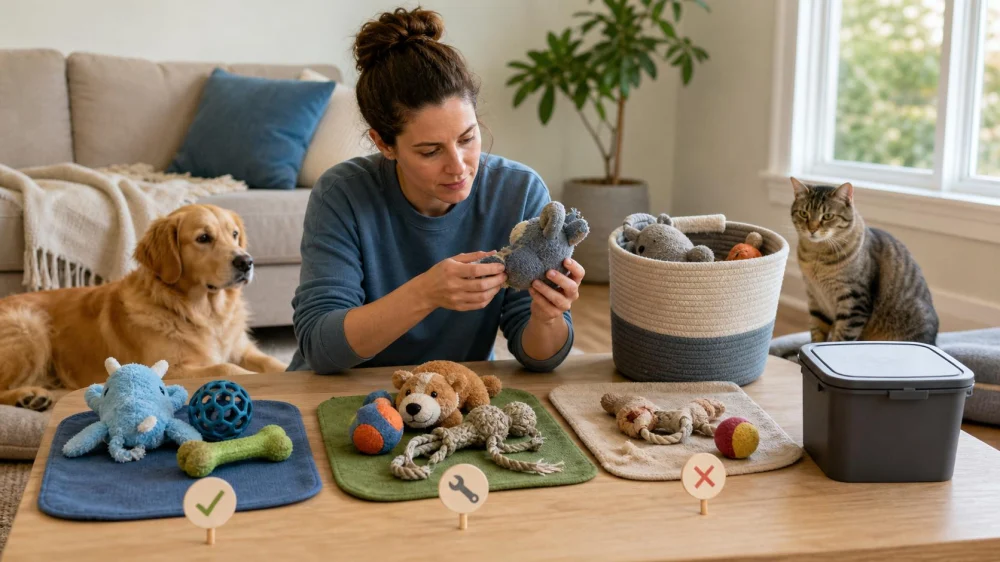
Collect the toys currently in use and inspect each one under good light. Create three groups: clean and keep, repair only if safety can be fully restored, and retire now. Record any missing component, clean intact toys according to their instructions, and return only options that still match each pet’s current size and behavior.


 Vetco Total Care Animal Hospital4.0 (134 reviews)
 Paws Inn Animal Hospital4.0 (234 reviews)
 SNiP Vet - Spay Neuter in Phoenix4.0 (272 reviews)
 43rd Avenue Animal Hospital4.0 (427 reviews)
 PetVet365 Pet Hospital Jeffersonville IN/North Louisville4.0 (108 reviews)
 Animal Clinic of Glasgow4.0 (394 reviews)
 Behind the Scenes of a Veterinary Clinic: What Happens in 24 Hours
 How to Help Dogs With Fear of Cars Using Safe Training Methods
 How Much Does a Vet Visit Cost? Realistic Price Ranges for Pet Owners
 Signs Your Dog Needs Immediate Veterinary Care: What Every Pet Owner Should Know
 How to Monitor Pet Vital Signs at Home Safely
 Evaluating New "Functional" Pet Foods: Trends & Claims