
Pet Microchip Audit: Verify the Number and Registry Record
On this page
Quick answer
A microchip helps only when its identification number leads to a current registry record. Ask a veterinary clinic or shelter to scan the pet, compare the full number with your documents, use the AAHA registry lookup to identify participating registries, and contact the actual registry to verify ownership and update phone, email, address, and backup contacts. The lookup itself does not update records.

Confirm the chip number
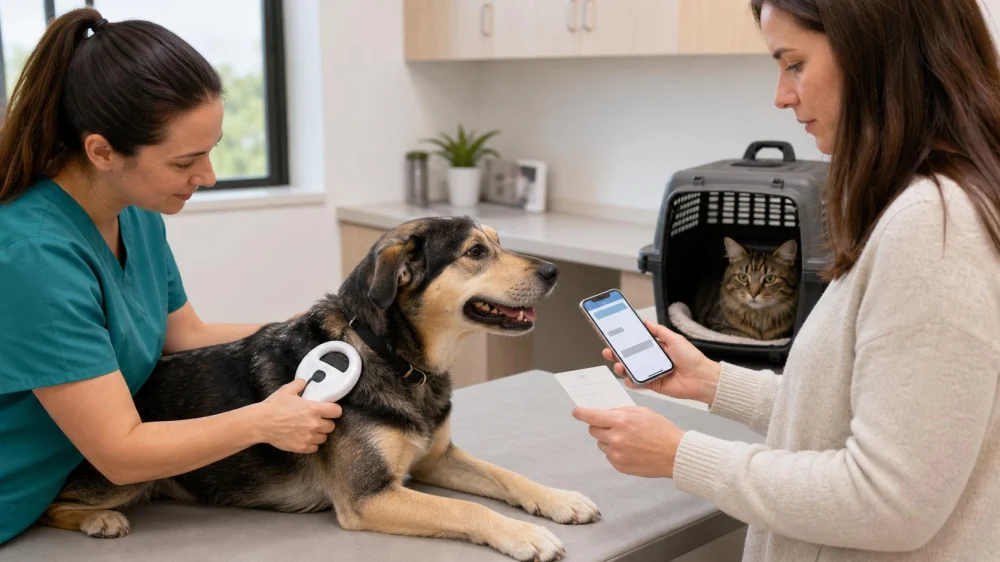
Find the implantation certificate, adoption record, veterinary file, or registry email. Microchip identifiers commonly contain 9, 10, or 15 digits, and one wrong digit can point nowhere. Do not rely only on a handwritten card. Ask a veterinary clinic or shelter to scan the pet and read the number directly.
Have the whole body scanned using the facility’s standard technique because chips can migrate from the original placement area. Compare the displayed number character by character with every record. If two different numbers appear, ask the veterinarian to document both and explain whether the pet may have more than one chip.
Cumberland Animal Hospital
Russell SpringsRussell CountyKentucky
103 Apache Ave #4105, Russell Springs, KY 42642, USA
Find the correct registry
A chip does not contain your name or telephone number. It stores an ID that a scanner reads; contact information is held by a separate registry service. Manufacturer, distributor, implanter, and registry may be different organizations. A chip can be implanted yet never registered to the pet owner.
In the United States, the American Animal Hospital Association provides a universal lookup that can identify participating registries associated with a number. Enter the digits without spaces or punctuation. The result may list several candidates, particularly for some number ranges. Contact the most recently reporting registry first and work through the list when needed.
Update useful contact details
Verify the pet’s name, species, description, primary owner, mobile number, email, physical address, and at least one reliable backup. Include a veterinarian or alternate contact only with their consent. If the registry supports status notes, use current factual information rather than a long medical history.
Ask whether the registry has renewal fees, paid optional services, transfer requirements, and a way to mark the pet lost. Basic registration terms vary. Save confirmation showing the number, registry, update date, and support contact, but store it securely rather than posting the full chip number publicly.
Protect privacy and account access
Use the registry’s verified website or phone number obtained from trusted records or the AAHA lookup. Phishing messages may claim a pet was found to collect passwords or money. Do not share account credentials or payment information through an unsolicited link. Contact the registry through a known channel.
Use a unique password and multifactor authentication when available. Confirm who can change ownership and what evidence is required. Microchip registration does not by itself settle every ownership dispute, so retain adoption, purchase, licensing, veterinary, and transfer documents as applicable.
Audit after life changes
Review the record at least annually and after moving, changing phone or email, changing veterinarian, separating households, transferring ownership, or losing access to an old account. Update backup contacts when relationships or availability change. A disconnected primary number can delay reunion even when the chip scans correctly.
Ask the veterinary team to scan during routine visits according to its practice policy, particularly before travel or after an adoption. A scan confirms the chip can be detected and the number matches the file; it does not prove that every registry field is current. Complete both checks.
Act quickly if the pet is lost
Notify the registry and mark the pet missing through its official process. Contact local shelters, animal control, veterinary clinics, and appropriate community lost-pet channels. Provide a current photo and safe contact method. Continue checking in person or as local organizations recommend because descriptions can be imperfect.
Watch for recovery scams. A legitimate finder or clinic may use the registry to contact you without revealing your private details directly. Do not send a verification code, password, or unverified payment to someone who claims to have the pet. Arrange recovery through a safe public or official channel when possible.
Frequently asked questions
Does the AAHA lookup register my pet?
No. It identifies possible registry companies and does not display owner information or update records. Contact the registry that maintains the chip’s record.
Does a chip replace an ID tag?
No. A visible tag can support immediate contact, while a chip provides permanent internal identification when scanned. Use both and keep each current.
What if the lookup returns no registry?
Confirm every digit with a fresh scan, retry later if a service failed, and contact the implanting clinic, adoption organization, manufacturer, or likely registries for trackback help.
Sources and limitations
The American Animal Hospital Association explains that a chip carries an ID number and that contact data lives in a registry in its microchipping FAQ. Its registry lookup guidance explains multiple matches, unregistered chips, and the lookup’s privacy limits. Registry participation and local ownership rules vary.
Conclusion and next steps
Have the pet scanned, match every digit, identify the registry through a trusted lookup, and verify the live account directly. Update primary and backup contacts after every change and keep secure proof. If the pet disappears, mark it lost immediately and use safe official channels for recovery.





 Bell Equine Surgery & Lameness5.0 (4 reviews)
 Eckert Veterinary Hospital4.0 (122 reviews)
 Midway Small Animal Clinic4.0 (142 reviews)
 Tail-End Vetcare4.0 (77 reviews)
 Pet Planet The Plant4.0 (84 reviews)
 VIP Petcare Vaccination Clinic5.0 (1 reviews)
 How to Stop Cats from Scratching Furniture: Effective Tips and Products
 Dog Drinking More Water? What Owners Should Track
 Tips for Helping Your Dog Adjust to a New Baby
 How to Monitor Pet Vital Signs at Home Safely
 Best Dog Harnesses for Adventure Activities
 Cat Straining to Urinate? Treat a Possible Blockage as an Emergency