
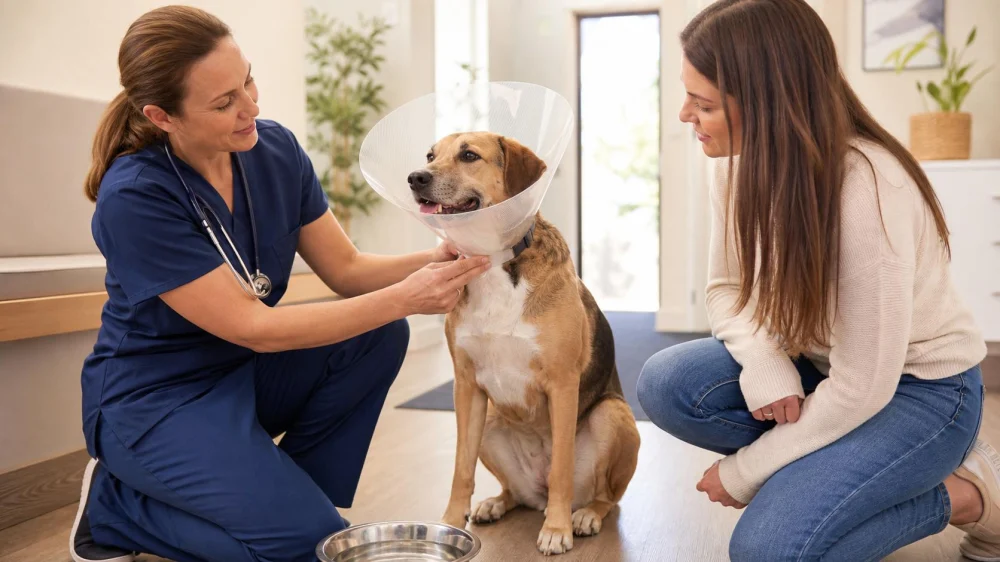
Pet Recovery Cone Fit: Reach, Food, and Safe Movement
On this page
Quick answer
A recovery cone must extend far enough to stop the pet reaching the protected site while staying secure without restricting breathing or swallowing. Ask the veterinary team to fit it and demonstrate removal and replacement. Test eating, drinking, resting, doorway clearance, stairs, and leash movement under supervision. Call the clinic if the pet can reach the site, cannot function safely, or develops neck irritation.
This guide supports dogs and cats after veterinary care. The treating veterinarian decides the device, fit, wear schedule, and whether any alternative protects the exact body area.
What the cone must do
An Elizabethan collar, or E-collar, is a rigid or soft cone that limits a pet's ability to lick, bite, scratch, or rub a wound, incision, bandage, or irritated area. It protects healing tissue only when its length, shape, closure, and attachment prevent access.
Comfort alone does not establish effectiveness. An inflatable ring may feel easier but allow a long dog to reach a hind leg. A recovery suit can cover an abdominal incision but not prevent scratching at an ear. Match the device to the pet's body, flexibility, behavior, and protected location.
Doc Lane's Veterinary Pharmacy
LexingtonFayette CountyKentucky
101 Venture Ct Suite 125, Lexington, KY 40511, USA
Fit checklist
- Confirm length. The cone rim should project far enough beyond the muzzle or face for the target area, as fitted by the clinic.
- Check neck space. Follow the veterinary team's finger-space test and fastening instructions; too loose can slip, while too tight can impair comfort or breathing.
- Check attachment. Thread the regular collar or ties only through the designed loops and use the demonstrated closure.
- Try the reach test. Under close supervision, observe whether the pet can bend around the rim to touch the protected site.
- Inspect edges. Look for cracks, sharp points, loose staples, chewed areas, and abrasive seams.
- Watch breathing and swallowing. There should be no coughing, gagging, noisy breathing, blue or pale gums, or neck compression.
- Mark the setup. Photograph the correctly fitted tabs and collar position for every caregiver.
Do not cut the cone shorter, add holes, or substitute ties without veterinary approval. A small change can restore the pet's reach or create a snag and choking hazard.
Set up the home
A cone changes peripheral vision and body width. Clear stools, cords, plants, narrow gaps, and lightweight objects the rim can catch or knock over. Block unsupervised stairs until the pet demonstrates safe movement, and provide a bed with room for the cone rim.
Keep the pet indoors or on controlled leash outings as instructed. Bushes, fences, crates, pet doors, and furniture can trap the rim. Check crate dimensions with the clinic; a crate that normally fits may become unsafe with a cone.
Introduce the cone in a calm room. Reward relaxed standing and movement if treats are allowed. Do not punish bumping or freeze responses. Contact the clinic when distress remains intense or the pet repeatedly risks injury trying to remove it.
Food, water, and walks
Use shallow, stable bowls if the rim cannot clear a deep bowl. A raised bowl may help some pets but can be inappropriate for others, so ask the veterinary team. Confirm the pet can reach water while the cone stays on.
Remove the cone for meals only if the veterinarian explicitly permits it and a responsible adult provides uninterrupted close supervision. Replace it exactly as fitted before attention shifts away. A pet can damage an incision in seconds.
For toilet breaks, use a secure leash and avoid brush, tight gates, and dog-to-dog contact. Do not attach the leash to a flimsy cone tie. Use the harness or collar arrangement approved after the procedure.
Monitor the pet and site
At least several times daily or as directed, inspect the neck for rubbing, moisture, swelling, hair loss, odor, or pressure marks. Clean both sides of the cone with the approved method, dry it fully, and supervise the pet if removal is permitted for cleaning.
Check the protected site only according to discharge instructions. Contact the clinic for new bleeding, opening, discharge, odor, swelling, missing sutures, a wet or shifted bandage, or renewed access by the pet. Do not apply bitter spray, ointment, padding, or tape near the site unless the veterinarian approves.
Track eating, drinking, urination, bowel movements, sleep, and medication. Refusal to eat or drink, repeated vomiting, breathing changes, profound lethargy, or inability to rest needs prompt veterinary advice.
Alternatives and limits
Soft cones, inflatable collars, neck braces, recovery suits, shirts, and specialized coverings may help some pets. None is universally interchangeable with a rigid cone. Ask the vet to test whether the pet can reach the exact site in normal bending, lying, and grooming positions.
Do not replace the prescribed cone because of an online size chart alone. Breed head shape, neck width, muzzle length, flexibility, and wound location change fit. Sedating a distressed pet is a veterinary decision; never give human sleep aids or leftover pet medication.
FAQ
Can my pet sleep in the cone?
Many pets need to wear it continuously, including during sleep. Provide enough space and follow the veterinarian's wear schedule.
How many fingers should fit at the neck?
Use the exact test demonstrated by your veterinary team. General guidance often refers to about two fingers, but anatomy and device design matter.
Why can my pet still reach the paw?
The cone may be too short, loose, flexible, or wrong for that location. Keep the pet supervised and call the clinic for refitting.
Can I tape a cracked cone?
A rough temporary patch can irritate or fail. Prevent site access and ask the clinic for a safe replacement.
When can the cone come off permanently?
Only when the treating veterinarian confirms the protected area has healed enough. Appearance alone is not a reliable clearance test.
Sources and evidence
Veterinary-authored E-collar guidance from VCA Animal Hospitals explains fit, supervised adjustment, eating, cleaning, and outdoor risks. The treating clinic remains the primary source for the individual pet and procedure.
Next steps
Have the veterinary team fit the cone, photograph the correct closures, test water and movement, and clear the home route. Put the clinic number and wear schedule in the handoff log, then recheck the neck, device, and protected site at every shift.



 Artistic Aquariums, Inc4.0 (407 reviews)
 BloomingPaws Clinic Resort & Spa4.0 (398 reviews)
 PetVet Vaccination Clinic5.0 (1 reviews)
 Decatur Veterinary Clinic4.0 (283 reviews)
 Alta Mesa Animal Hospital4.0 (584 reviews)
 U-Vet Animal Clinic4.0 (236 reviews)
 Genetic Testing for Pets: What You Can Learn & What’s Useful
 Vet Tips for Preventing Puppy Ear Infections
 How to Start a Pet Garden with Safe Plants
 3D Imaging & Pet Diagnostics: What You Should Know
 Gastrointestinal Upset in Pets: Diarrhea, Vomiting, and What to Feed
 Best Practices for Pet Grooming Frequency by Breed: Keeping Your Pet’s Coat Healthy