
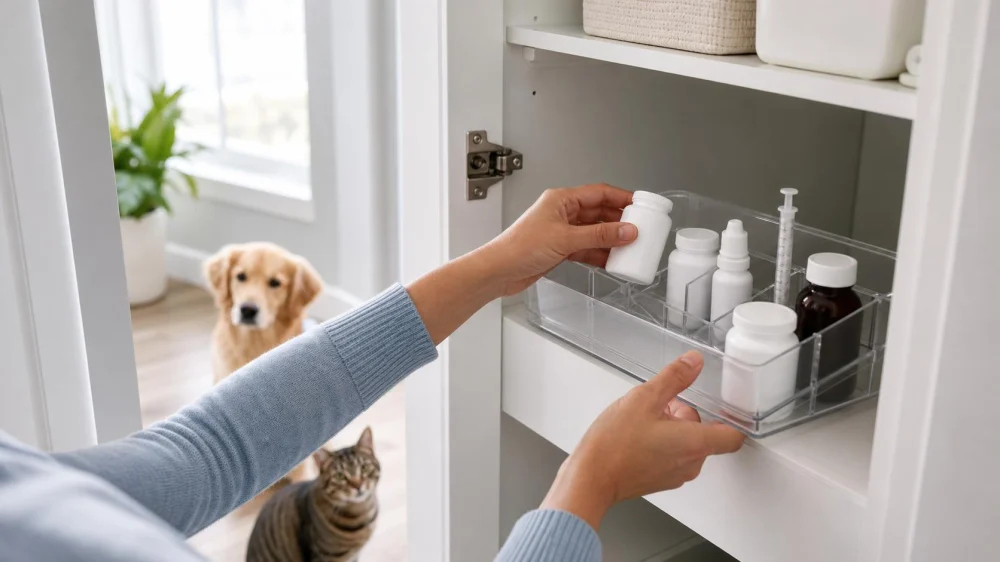
How to Store Pet Medications Safely at Home
On this page
- Quick answer
- Why medication storage matters
- Build a safer storage system
- Prevent wrong-pet and wrong-dose errors
- Set up each dose safely
- Handle expired or unwanted medicine
- What to do after a possible exposure
- Monthly medication safety checklist
- Important limitations
- Frequently asked questions
- Sources and evidence notes
- Conclusion and next steps
Quick answer
Keep every pet medication in its original, clearly labeled container and in a secured location that pets and children cannot reach or open. Separate animal medicines from human medicines and separate each pet's products. Follow the label's temperature, light, and refrigeration directions. Record each dose, close the container immediately, and contact a veterinarian after any mix-up or accidental exposure.
Safe medication storage means preserving the product as directed while preventing unauthorized access, mix-ups, contamination, and accidental overdose.

Why medication storage matters
A high shelf is not necessarily secure: cats climb, dogs pull items from counters, and a container can be knocked to the floor. Child-resistant packaging may not withstand chewing. Flavored pet tablets can be especially attractive to an animal that finds the entire supply.
Errors also occur when animal and human products are stored together, two pets have similar containers, or a caregiver cannot tell whether a dose was already given. A simple storage and record system reduces these preventable risks without changing the veterinarian's treatment plan.

Build a safer storage system
- Read the label first. Follow its directions for temperature, light, moisture, refrigeration, handling, and expiration. Ask the pharmacy or clinic if anything is unclear.
- Keep the original container. Preserve the intact label with the pet's name, medicine, strength, directions, pharmacy, and prescription information.
- Choose a secured location. Use a closed cabinet or container that the animals and children in the home cannot access. Consider climbing, jumping, chewing, and determined searching.
- Separate categories. Store pet medicines away from human medicines. Within the pet area, use distinct sections for each animal without covering official labels.
- Protect refrigerated products. Place them in a stable, clearly separated bin as directed; do not freeze unless the label specifically says to.
- Secure supplies. Keep dosing syringes, needles, pill cutters, medicated creams, patches, and sharps containers controlled as well.
Do not transfer tablets to an unlabeled bag or household food container. Do not combine refills with old medicine unless a pharmacist or veterinarian confirms it is appropriate; strength, formulation, lot, and expiration may differ.
Prevent wrong-pet and wrong-dose errors
- Create one current list for each pet: medicine name, label strength, amount, route, schedule, purpose, and prescribing clinic.
- Use a written or digital dose log that all caregivers update immediately.
- Check the pet, container label, amount, route, and time before every administration.
- Keep the correct measuring device with the product without obscuring its label.
- Do not share medicine between animals, even when their symptoms appear similar.
- Do not cut, crush, open, or mix a dosage form unless the veterinarian approves it.
- Ask the clinic what to do after a missed, late, spilled, or vomited dose; never automatically double the next dose.
This system is best for multi-pet or multi-caregiver households because it makes ownership and dose status visible. It is not a substitute for reading the prescription label at every dose.
Set up each dose safely
- Work in a well-lit, distraction-free area with only one pet's medicine present.
- Read the label and measure the dose exactly with the specified device.
- Keep other pets and children away during preparation and administration.
- Confirm the dose was swallowed or applied as instructed without forcing unsafe handling.
- Close and return the container to secure storage immediately—before rewarding the pet or doing another task.
- Record the dose and any unusual response.
For topical human medicines, prevent pet contact with the product, tube, treated skin, discarded applicators, and contaminated fabric according to the prescriber's and product's directions. Some human products can cause serious harm after a pet chews a container or licks treated skin.
Handle expired or unwanted medicine
Do not keep leftovers for a future illness or give them to another animal. The FDA identifies community drug take-back programs as the preferred disposal option for many unwanted medicines. Ask the veterinarian or pharmacist about the specific product and local options.
Do not flush medicine unless it appears on the FDA flush list or a relevant authority specifically instructs you. When household-trash disposal is appropriate, follow current FDA directions and prevent pets from reaching the trash. Used needles and other sharps require an appropriate sharps container and local disposal route; never place loose sharps in household recycling.
What to do after a possible exposure
- Move the pet away from the product without exposing yourself.
- Collect the container, label, remaining contents, and any chewed packaging.
- Call your veterinarian, an emergency animal hospital, or an animal poison control center promptly.
- Report the species, weight if known, product, strength, possible amount, time, symptoms, and other medicines.
- Follow professional instructions and bring the packaging if directed.
Do not wait for symptoms when a potentially harmful exposure occurred. Do not induce vomiting or give milk, food, oil, salt, hydrogen peroxide, charcoal, or another remedy unless a veterinary professional specifically directs it for that animal and exposure.
Monthly medication safety checklist
- All containers are original, closed, legible, and assigned to the correct pet.
- The cabinet or storage box still resists access by every pet and child in the home.
- Human and animal medicines remain separate.
- Refrigerated products are stored at the label-directed conditions.
- The medication list matches current veterinary instructions.
- Expired, stopped, or unwanted products are isolated for approved disposal.
- Dosing tools are clean, distinguishable, and used only as directed.
- Emergency veterinary and poison-control contact information is current.
Important limitations
This article provides general prevention guidance, not instructions for a particular drug. Product labels and veterinary directions take priority. Storage, handling, disposal, and exposure risks differ for tablets, liquids, insulin, chemotherapy drugs, hormones, topical creams, transdermal patches, controlled substances, compounded medicines, and sharps.
Call the prescribing clinic rather than guessing when a label is damaged, the medicine changed appearance, refrigeration failed, a dose was measured incorrectly, or one pet received another pet's product. Call 911 for a human life-threatening emergency; use Poison Control or a healthcare professional for human exposure as appropriate.
Frequently asked questions
Is a kitchen counter high enough for pet medicine?
No. Animals may climb, jump, pull down containers, or chew packaging. Use genuinely secured storage that accounts for the abilities of pets and children in the home.
Can I put pet pills in a weekly organizer?
Ask the veterinarian or pharmacist first. Removing medicine from the original container can lose critical label information and may affect safe storage. If an organizer is approved, it must remain secured and accurately tracked.
Should pet and human medicines share one locked box?
A locked location is helpful, but separation inside it is still important to prevent selection errors. Keep products for each person and animal clearly divided while retaining original labels.
What if my pet ate its own medicine?
An animal can overdose on its own prescribed product. Call a veterinarian, emergency animal hospital, or animal poison control center immediately with the label and possible amount.
How should liquid medication be measured?
Use the device and unit specified by the veterinarian or pharmacy. Confirm whether the product must be shaken and how to read the markings. Do not substitute a kitchen spoon.
Sources and evidence notes
The U.S. Food and Drug Administration advises keeping pet medicines in original labeled containers, securing them from pets and children, separating animal and human medicines, and disposing of unwanted products appropriately in its guide to proper pet medication storage. Its veterinary medication error guidance also recommends reading labels, maintaining a medication list, avoiding unapproved tablet alteration or sharing, and preventing accidental exposure.
Conclusion and next steps
Audit the home today: move every human and animal medicine into separated, secured storage; preserve the labels; create one current list per pet; and set up a dose log. Ask your veterinarian or pharmacist about any product-specific uncertainty. Pet & Puppy can help you explore veterinary clinic options, but only a veterinary professional familiar with the patient should direct treatment.

 Animal Care Clinic4.0 (230 reviews)
 Plantation Veterinary Clinic4.0 (131 reviews)
 Animal Hospital-Nicholasville: Fox Julie DVM4.0 (33 reviews)
 Niki's Place4.0 (367 reviews)
 Vetco Vaccination Clinic4.0 (28 reviews)
 Bilby's BallRoom Middletown4.0 (55 reviews)
 The Impact of Indoor Air Quality on Pet Respiratory Health
 How to Help a Pet Deal with Anxiety After Trauma
 Puppy Behavior: Why Do Puppies Bite and How to Stop It
 Behavioral Cues That Suggest a Vet Visit Is Needed
 Drones & Robotics in Pet Care: What’s Possible Now
 3D Imaging & Pet Diagnostics: What You Should Know