
Pet Food Recall Check: Save the Label, Match the Lot, and Call Your Vet
On this page
Quick answer
If you hear about a pet food recall, verify it through the FDA, the manufacturer, or another official notice. Match the exact product name, recipe, package size and type, lot code, best-by or expiration date, and UPC when provided. Do not feed a product that matches the notice. Secure it away from pets, children, wildlife, and other food, then follow the recall's return, disposal, cleaning, and veterinary instructions.
If a pet is ill or may have eaten the affected food, call a veterinarian promptly. Do not wait for online comments to confirm a health risk.
Verify the recall source
Social posts and screenshots can omit lot numbers, expand a recall beyond the affected product, or remain online after an update. Open the current FDA advisory or recall announcement and the manufacturer's official notice. Compare publication and update dates.
- FDA animal food advisories and recall pages
- Manufacturer's official website and contact details
- Retailer's notice linked to the original recall
- Veterinarian or public-health instructions
- Current updates about expanded or terminated recalls
Match the complete product identity
A brand name alone is not enough. FDA explains that the lot number identifies a particular batch and can help trace the plant and production date. Locate it on every layer of packaging, because the outer case and individual container may carry different useful codes.
- Photograph the front and back of the package.
- Photograph the lot code and date in focus.
- Record product name, flavor or recipe, size, and package type.
- Record UPC, purchase date, and store or seller.
- Compare every element with the official notice.
When uncertain, stop using the product and contact the company or FDA rather than guessing.
Isolate the product safely
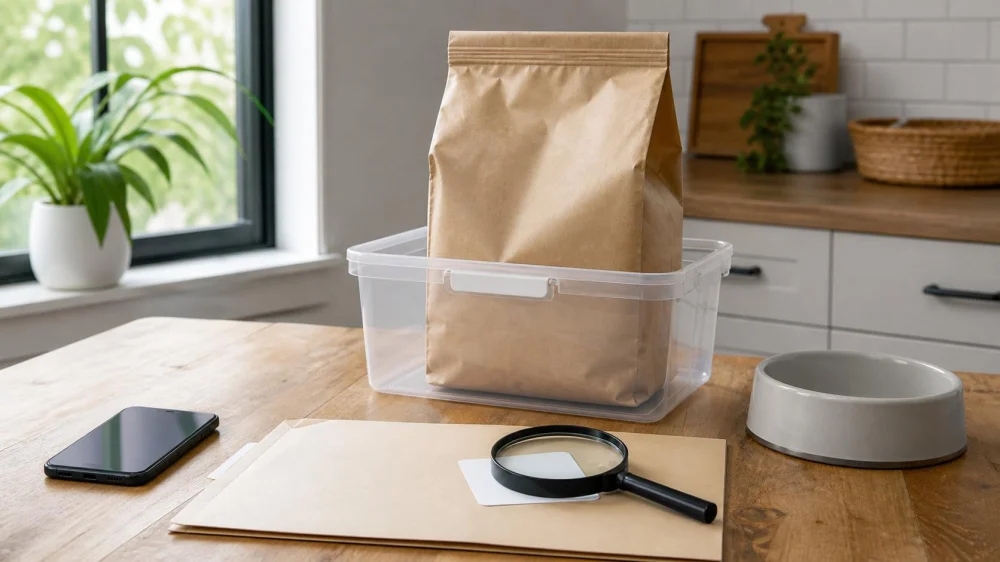
Keep the package closed when possible and place it in a secondary leak-resistant container away from people and animals. Do not donate, resell, compost, or feed it to wildlife. Do not return it until you read whether the notice or investigator asks consumers to retain a sample or packaging.
Clean bowls, scoops, storage bins, counters, and hands according to the specific recall instructions. Avoid creating dust or splashes from suspect food.
Record the pet's exposure and condition
Write down which pets ate the product, the approximate amount, first and last feeding dates, and whether any pet sharing the food remains unaffected. Record symptoms, onset, trend, other foods or treats, medicines, supplements, and relevant health conditions.
Call the veterinarian for illness, injury, or recall-specific screening advice. Seek emergency veterinary care for severe or rapidly worsening symptoms as directed by a clinician or poison-control service.
Prepare a useful report
FDA accepts pet food complaints through its safety reporting process. Useful information includes the complete product identity, lot and date, purchase source, storage and handling, remaining quantity, package condition, the pet's history and signs, veterinarian contact, and relevant records.
A report does not prove the product caused an illness, but complete details can support surveillance and follow-up. Keep confirmation numbers and copies of attachments.
Preserve records before a problem
Keep original pet food packaging until the product is consumed, or at minimum save clear photographs of the label, lot code, best-by date, UPC, ingredients, and manufacturer contact. Do not mix new food into crumbs from an older batch. Record when a new bag, case, or container begins.
Store food according to its label and keep the original identification linked to any secondary container.
Important limitations
This is general U.S. recall-response guidance, not veterinary diagnosis, treatment, toxicology, legal, or disposal advice. Recall instructions differ by hazard and product. Follow the current official notice and individualized veterinary guidance.
Evidence notes
FDA identifies the lot number and use-by date as especially important for tracing pet food complaints and recommends preserving original packaging. Its reporting process collects product, purchase, handling, exposure, pet, veterinarian, and diagnostic details.
FAQ
Does a recalled brand mean every product is affected?
Not necessarily. Match the exact product and lot details in the official notice.
Where is the lot code?
Location varies; check the entire bag, can, pouch, case, seal, and nearby date markings.
Should I throw the food away immediately?
Read the notice first because return, disposal, or sample-retention instructions may differ.
Should I call the veterinarian if my pet seems normal?
Follow the recall's veterinary guidance and call with exposure questions, especially for higher-risk pets.
Can I report a product problem if no pet is sick?
FDA states that consumers can report product problems even without an affected animal.
Next steps
Open the current official notice, photograph and match every package code, isolate any matching or uncertain product, and call the veterinarian about exposure or symptoms. Preserve records and use the official reporting channel when appropriate.
 Winchester Veterinary Clinic4.0 (250 reviews)
 Prices Creek Veterinary Service4.0 (190 reviews)
 Petland Austin Landing4.0 (119 reviews)
 Coffey's Vet Center4.0 (223 reviews)
 VCA Parkdale Animal Hospital4.0 (177 reviews)
 Feeders Pet Supply4.0 (209 reviews)
 How to Help Dogs With Anxiety at Night
 Why Do Dogs Shake Their Whole Body Suddenly? Causes Explained
 Best Flea and Tick Prevention for Puppies: Complete Guide
 Best Dog Harnesses for Outdoor Adventures: Comfort, Safety, and Durability
 Why Do Dogs Groom Themselves After Eating? Understanding the Behavior
 Dog Collar and Harness Fit Check: An Everyday Safety Guide