
How to Photograph a Dog's Skin Change for the Veterinarian
On this page
- Quick answer
- Decide whether photography is safe
- Set up light, focus, and scale
- Capture a repeatable photo sequence
- Record symptoms and context
- Build a useful timeline
- Share securely with the clinic
- Photo-record checklist
- Limitations and urgent signs
- Frequently asked questions
- Veterinary safety notes
- Take three views today
Quick answer
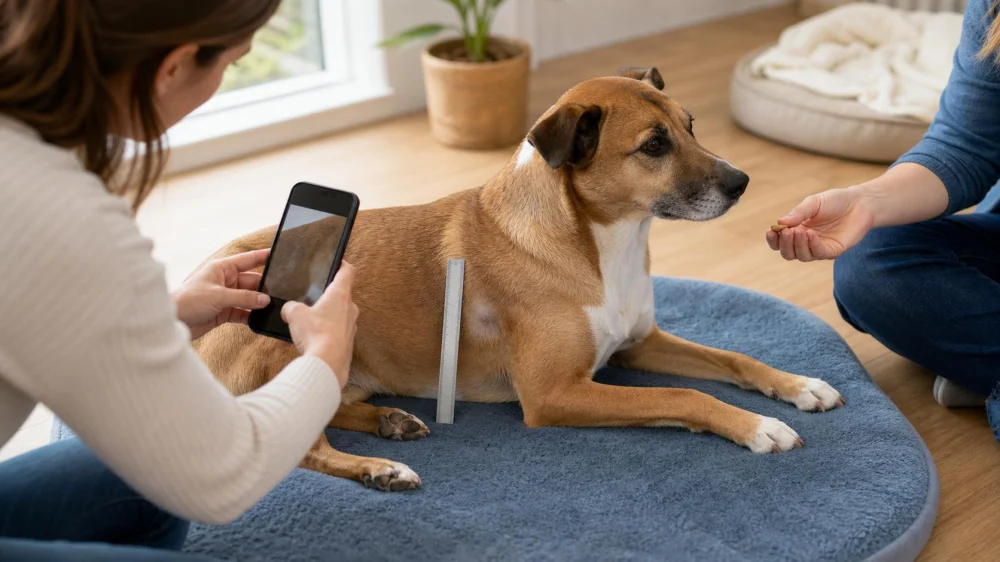
Take three well-lit photos of a dog's skin change: one showing where it is on the body, one medium view showing the surrounding coat and skin, and one close view with a clean ruler beside—but not touching—the area. Keep camera distance, lighting, angle, and scale consistent for follow-up images. Record the date, size, color, texture, discharge, odor, hair loss, pain, itch, licking, and any change in behavior or general health.
Photos help a veterinarian see a timeline, but they cannot diagnose the cause or replace touch, microscopy, sampling, and other examination.

Decide whether photography is safe
Do not restrain a painful, frightened, snapping, or struggling dog for a picture. Ask a helper to offer calm rewards only if the dog is comfortable. Stop if handling changes breathing, causes distress, or risks a bite.
Do not squeeze, scrape, puncture, shave, wash, apply cream, remove a scab, or clean discharge just to improve the image unless the veterinarian has instructed you. Photograph first when safe because treatment can change appearance.

Set up light, focus, and scale
Use bright indirect daylight or a diffuse lamp. Avoid harsh flash reflection and colored room lighting. Clean the phone lens and tap the area on screen to focus. Hold the camera parallel to flat skin when possible so shape is not distorted.
Place a washable ruler or standardized scale next to the area without touching broken skin. Do not use a coin if contamination or size ambiguity is a concern. Include one image without the scale so it does not hide edges.
Capture a repeatable photo sequence
First photograph the whole dog from a respectful distance and point to the general region without covering it. Second, capture the body part and nearby landmarks. Third, take a sharp close-up that includes the full margin. Add a side angle only when height or swelling matters.
For multiple areas, assign simple location names such as left shoulder, right outer thigh, or underside near the chest. Do not use image filters, portrait blur, color enhancement, or digital markup on the only original. Keep the unedited file with metadata.
Record symptoms and context
Write when the change was first noticed and whether it appeared suddenly or gradually. Note scratching, licking, rubbing, tenderness, heat, swelling, bleeding, crust, scale, moisture, odor, hair loss, or spread. Record appetite, water intake, energy, elimination, breathing, and other changes without trying to interpret them.
List recent grooming, boarding, travel, outdoor exposure, new animals, foods, treats, medications, supplements, flea or tick products, household cleaners, plants, and known injuries. Include exact product labels when relevant.
Build a useful timeline
Repeat photos only at an interval the clinic recommends or when a meaningful change occurs. Use the same room, light, orientation, distance, and ruler. Name each file with date, body location, and sequence.
Measure the longest dimension and the widest perpendicular dimension without pressing the skin. If the edge is unclear, state that rather than drawing a precise border. A photograph can look larger simply because the camera moved closer.
Share securely with the clinic
Contact the veterinary practice before sending files and use its portal, email, or messaging process. Include the dog's name and concise timeline in the message, not sensitive information in a public album link. Ask whether an appointment is needed and what changes require faster care.
Do not crowdsource a diagnosis from public posts. Different infections, parasites, allergies, tumors, injuries, and inflammatory conditions can look similar in a photograph and require different testing or treatment.
Photo-record checklist
- Confirm handling is comfortable and safe.
- Use neutral light and a clean lens.
- Capture body-location, medium, and close views.
- Add a clean scale without touching the lesion.
- Keep the original images unedited.
- Record symptoms, products, and exposures.
- Repeat with consistent setup when advised.
- Send through the clinic's approved channel.
Limitations and urgent signs
- Color, scale, depth, warmth, pain, odor, and texture may not be represented accurately.
- Do not delay care for rapid swelling, breathing difficulty, collapse, severe pain, major bleeding, widespread blistering, facial swelling, suspected toxin exposure, or rapidly worsening illness.
- Eye, mouth, genital, deep, infected-looking, or extensive wounds may need prompt in-person examination.
- Call a veterinarian for situation-specific triage.
Frequently asked questions
Should I shave the hair around the area?
No, not for a photo unless the veterinary team directs it. Clippers can injure inflamed skin or change the evidence.
Can I use flash?
Use it only if needed and compare with a no-flash image; glare and color shift can hide detail.
How many photos should I send?
Send a small, organized set that shows location, context, detail, and change rather than dozens of near-duplicates.
Should I include a video?
A short clip can show scratching, movement, or changing swelling, but do not provoke symptoms.
Can a veterinarian diagnose from a photo?
Sometimes a photo narrows concern or supports triage, but many skin problems require an in-person examination and tests.
Veterinary safety notes
FDA guidance states that photos and videos alone do not establish the federal veterinarian-client-patient relationship required for certain prescribing and that veterinarians must remain involved in prescription animal-drug decisions. If an animal is sick or has an emergency, FDA directs owners to a veterinarian or emergency animal hospital.
Take three views today
If your dog is comfortable, take one location view, one surrounding-skin view, and one close view with a clean scale. Record the date and call the clinic to ask how and when it wants the images.

 Glasgo Memorial Veterinary Hospital4.0 (222 reviews)
 VCA Animal Hospitals Urgent Care - Chandler4.0 (59 reviews)
 Curem Veterinary Care4.0 (123 reviews)
 Central Kentucky Veterinary Services4.0 (231 reviews)
 Winchester Veterinary Clinic4.0 (250 reviews)
 easyvet Veterinarian San Tan Valley4.0 (385 reviews)
 How to Help a Dog With Sensitive Ears: Care Tips Every Owner Should Know
 Why Do Dogs Have Bad Breath and What Helps
 Why Do Dogs Make Weird Sounds While Sleeping? Understanding Canine Sleep Behavior
 What to Know About Canine Pancreatitis Symptoms, Causes & Care
 How 3D Printing Is Being Used in Pet Prosthetics & Surgery
 How to Teach Your Dog Advanced Tricks: A Step-by-Step Guide